
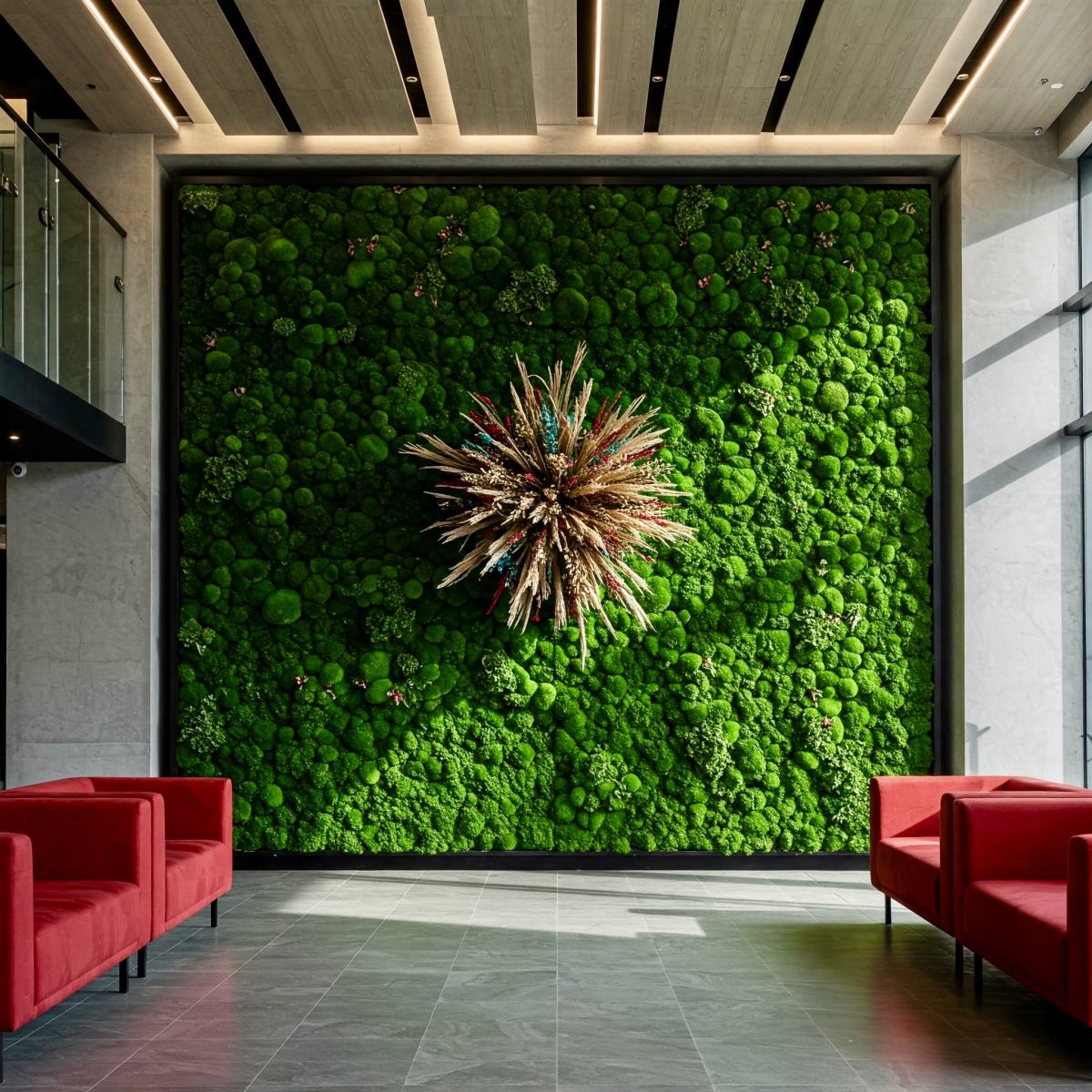
At a recent talk, I was extolling the benefits of vertical greenery (moss walls and frames in a classroom in this instance) and was asked an important question:
How long does the stress recovery last? i.e., if it only takes one minute for blood pressure and cortisol to drop, how long are those benefits sustained?
That important question led me down a path to find the answers not only to that question but also to corresponding questions regarding light, distance, and design strategies for leveraging the benefits of moss walls and designs.
What follows is data on the science of wellbeing along with guidelines for implementing and optimizing green walls in interior environments.
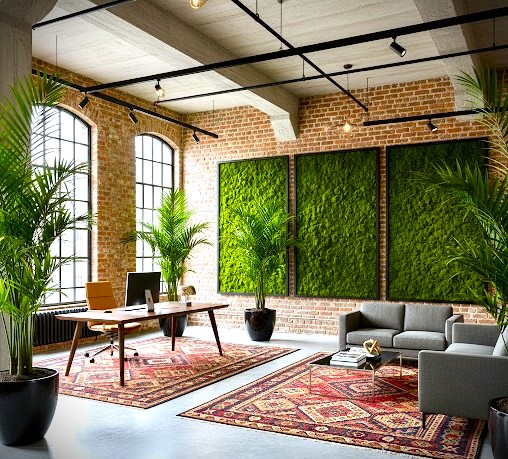
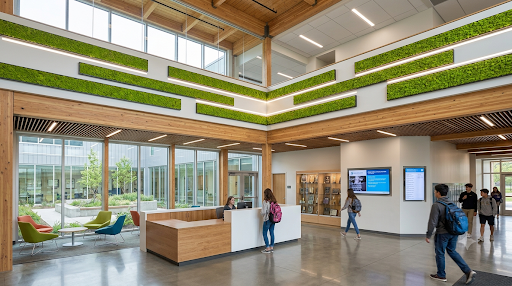
The square footage of the moss in this space along with ample natural light make for an ideal environment for attention and focus. Biophilic Design by: The Fat Plant Society
For decades, indoor plants and vertical greenery were seen as decorative afterthoughts, or superfluous (and costly to maintain) amenities added to standard office layouts to polish a corporate image or satisfy environmental credentials.
Now that we are a decade down the road in terms of modern biophilic design and green walls, we have access to greater data that supports the fact that strategic visual access to interior greenery directly alters brain chemistry, restores cognitive function within minutes, and generates measurable operational returns.
This piece provides data and the science behind how and why natural elements influence human physiology. It is immensely exciting that now, architects, designers, and workplace strategists can transform passive interior architecture and design into high-performing spatial infrastructure that mitigates fatigue, lowers workplace stress, and sharpens cognitive performance.
The Onset and Duration of Biophilic Recovery
The human autonomic nervous system responds almost immediately to natural geometry, leaf structures, and organic textures. When an individual looks up at greenery in an interior space, stress indicators—such as salivary cortisol, heart rate, and blood pressure—begin to stabilize in as little as 60 to 90 seconds.
However, the key operational question for workspace managers and biophilic designers centers on sustainability: how long do these physiological and psychological benefits persist after the visual encounter?
DIRECTED ATTENTION (Prefrontal Cortex) High Effort • Rapid Fatigue • Task-Driven │ ▼ [ Visual Interruption / Micro-Break ] │
▼ SOFT FASCINATION (Default Mode Network) Low Effort • Subconscious • Fractal Processing │ ▼ RESTORATION & PREFRONTAL CORTEX RECOVERY
The duration of recovery can be divided into two distinct operational modes:
Immediate Post-Viewing Duration (The Carryover Effect)
- Physiological Stabilization (15–30 Minutes): Following a 1- to 5-minute visual break spent observing interior greenery, heart rate variability (HRV) and blood pressure remain in a parasympathetic (“rest-and-digest”) state for roughly 15 to 30 minutes, provided the user does not encounter an immediate acute stressor.
- Cognitive Restoration (20–45 Minutes): Visual engagement with plant structures allows the prefrontal cortex to disengage top-down directed attention mechanisms. Working memory performance and executive control remain heightened for 20 to 45 minutes following brief biophilic micro-breaks.
Of course, the stabilization and cognitive benefits are easily restored by looking up at a moss wall again for just one minute.
Sustained Ambient Presence (The Baseline Shift)
When green walls, preserved moss panels, or dense plantings remain permanently within the primary field of view, the brain does not simply habituate to them until the effect vanishes. While the initial novelty levels off, baseline stress metrics remain lower throughout the workday, and the standard afternoon cognitive decline—typically observed around 2:00 PM—is flattened.
| Exposure Type | Key Mechanism | Physiological Outcome | Duration of Benefit |
|---|---|---|---|
| Micro-Break Focus | Direct visual interaction (1–5 \text{ min}) | Rapid parasympathetic activation; lowered cortisol | 15–45 \text{ minutes} post-viewing |
| Ambient Presence | Peripheral & direct visual integration | Flattened mental fatigue curve; lowered baseline stress | Sustained throughout work hours |
Neurological Mechanics: Soft Fascination and Fractal Fluency
To optimize spatial design, it is essential to understand why the brain responds so uniquely to natural patterns compared to built geometry.
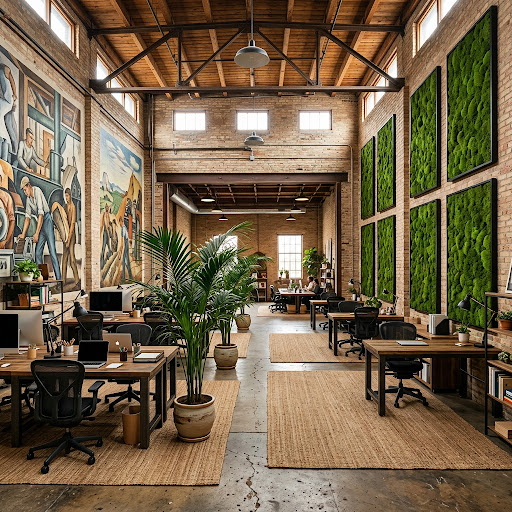
Deep green, textural pillow moss, potted palms, and natural jute rugs complement Thomas Hart Benton-inspired art in this wellbeing workplace. Biophilic Design by: The Fat Plant Society
Directed Attention Fatigue vs. Involuntary Processing
Modern workplace tasks (such as writing code, reviewing legal documents, or evaluating financial spreadsheets) rely on directed attention regulated by the prefrontal cortex. This mode demands continuous inhibition of extraneous distractions, rapidly consuming glucose and leading to fatigue, increased error rates, and irritability.
Conversely, natural elements engage involuntary attention—a state environmental psychologists call Soft Fascination. We have been sharing information about the importance of soft fascination for a decade and we never tire of explaining it again–it is one of the most important things we can offer our brains. And it is so easy to access.
Nature captures visual interest effortlessly without demanding deliberate concentration.
This gives the prefrontal cortex the necessary respite to replenish its inhibitory mechanisms.
Fractal Fluency and Visual Geometry
Plants present statistical fractals—patterns that repeat self-similar structures across varying scales (such as fern fronds, moss walls and large moss frames, and leaf venation).
- Mid-Range Fractal Dimension (D = 1.3 – 1.5): Human visual processing has evolved to interpret mid-range fractal complexity effortlessly.
- Alpha Wave Stimulation: Electroencephalogram (EEG) studies demonstrate that viewing mid-range natural fractals triggers an immediate increase in frontal alpha brain waves, signaling a state of relaxed awareness.
- Default Mode Network (DMN) Modulation: Soft fascination gently engages the brain’s Default Mode Network, facilitating problem-solving, creative synthesis, and emotional regulation without inducing anxious rumination.
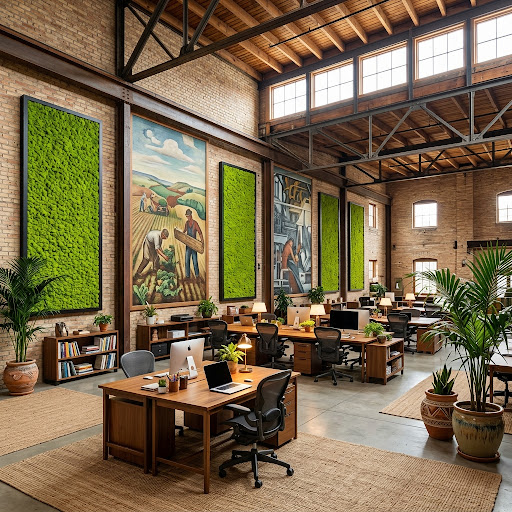
Light, natural textures and views of the large moss frames from every angle make this biophilic workspace as peaceful as it is productive. Biophilic Workplace Design by: The Fat Plant Society
Translation to Spatial Design Strategies
Translating neurological principles into physical environments requires aligning plant density, lighting angles, and texture placement with human sightlines and daily cognitive workflows.
+-------------------------------------------------+ | PRIMARY SIGHTLINE (0° - 30°) | | • High-impact feature walls / Moss Walls | | • Mid-range fractal textures (Pillow/Reindeer) | +----------------------------- --------------------+ │ ▼ +----------------------------- --------------------+ | PERIPHERAL FIELD (30° - 60°) | | • Low-profile panels & desk accent greens | | • Continuous ambient organic grounding | +----------------------------- --------------------+
Strategic Sightline Integration
- Primary Focus Zones (0^\circ – 30^\circ): Position high-texture green elements, such as acoustic moss panels or green walls, directly within the primary visual cone relative to screen/desk posture. This enables occupants to glance up for rapid restoration without breaking posture or concentration flow.
- Decision Thresholds: Install feature elements at architectural transition points (elevator lobbies, hallway intersections, and break spaces) to reset stress baselines as individuals transition between tasks.
Architectural Lighting and Color Rendering
- Grazing Light Angles: Angle low-glare accent lights at 15^\circ – 30^\circ across green surfaces. The resulting micro-shadows highlight three-dimensional organic depth, reinforcing fractal perception.
- Color Temperature & Rendering: Utilize high CRI (90+) light fixtures tuned between 3000\text{K} and 3500\text{K} to render true green tones without introducing harsh, cold blue spikes that disrupt the calming effect.
| Parameter | Technical Specification | Neurological Objective |
|---|---|---|
| Viewing Distance | 4 – 12\text{ feet} from primary desk seat | Enables seamless sightline shifts between screen and plant geometry |
| Surface Relief | 1″ – 4″ dimensional variation | Maximizes fractal dimension (D) and surface shadow interaction |
| Lighting Alignment | 15^\circ – 30^\circ grazing angle; high CRI (90+) | Enhances micro-textures without causing glare or visual fatigue |
| Color Spectrum | Deep forest green, sage, lichen tones | Calms the autonomic nervous system and signals safety |
The Business Case: Quantifying the ROI of Interior Biophilia
For corporate leaders and facility executives, biophilic integration must demonstrate clear commercial value. Empirical research measures productivity returns across four core financial metrics: cognitive performance, error reduction, workforce health, and talent retention.
Cognitive Performance and Output
Comprehensive workplace research—including multi-year studies by Professor Marlon Nieuwenhuis and international teams across commercial offices in Europe—demonstrates that transforming lean, sterile environments into lean-enriched, biophilic workspaces yields a 15% increase in overall workforce productivity. Employees process information faster, perform better on memory tests, and sustain focus longer into the afternoon.
Error Reduction in High-Cognitive Tasks
By preventing prefrontal cortex exhaustion, biophilic elements help maintain task accuracy. In data-heavy, analytical, or detail-intensive roles, visual access to greenery directly correlates with lower operational error rates over continuous work blocks.
Absenteeism and Well-Being
Reduced cortisol levels translate directly into physical health benefits. Studies show that employees with visual access to natural elements experience lower rates of eye strain, fewer headaches, and reduced subjective fatigue, contributing to measurable decreases in short-term sick leave.
Talent Attraction and Cultural Value
According to global research summarized in the Human Spaces Report, employees in workspaces enriched with natural elements report a 15% higher baseline of overall well-being, 6% higher productivity, and 15% higher creativity. The presence of biophilic design acts as a visual signal of investment in employee health, influencing recruitment and retention.
| Business Metric | Empirical Outcome | Financial Impact |
|---|---|---|
| Work Output | +15\% increase in overall productivity | Higher throughput on high-value tasks |
| Cognitive Accuracy | Reduced error rates during afternoon hours | Lower rework and quality-control costs |
| Workforce Well-Being | Lower short-term sick leave & fatigue | Reduced absenteeism and operational friction |
| Talent Metrics | +15\% increase in perceived employee well-being | Higher employee retention and lower recruiting costs |
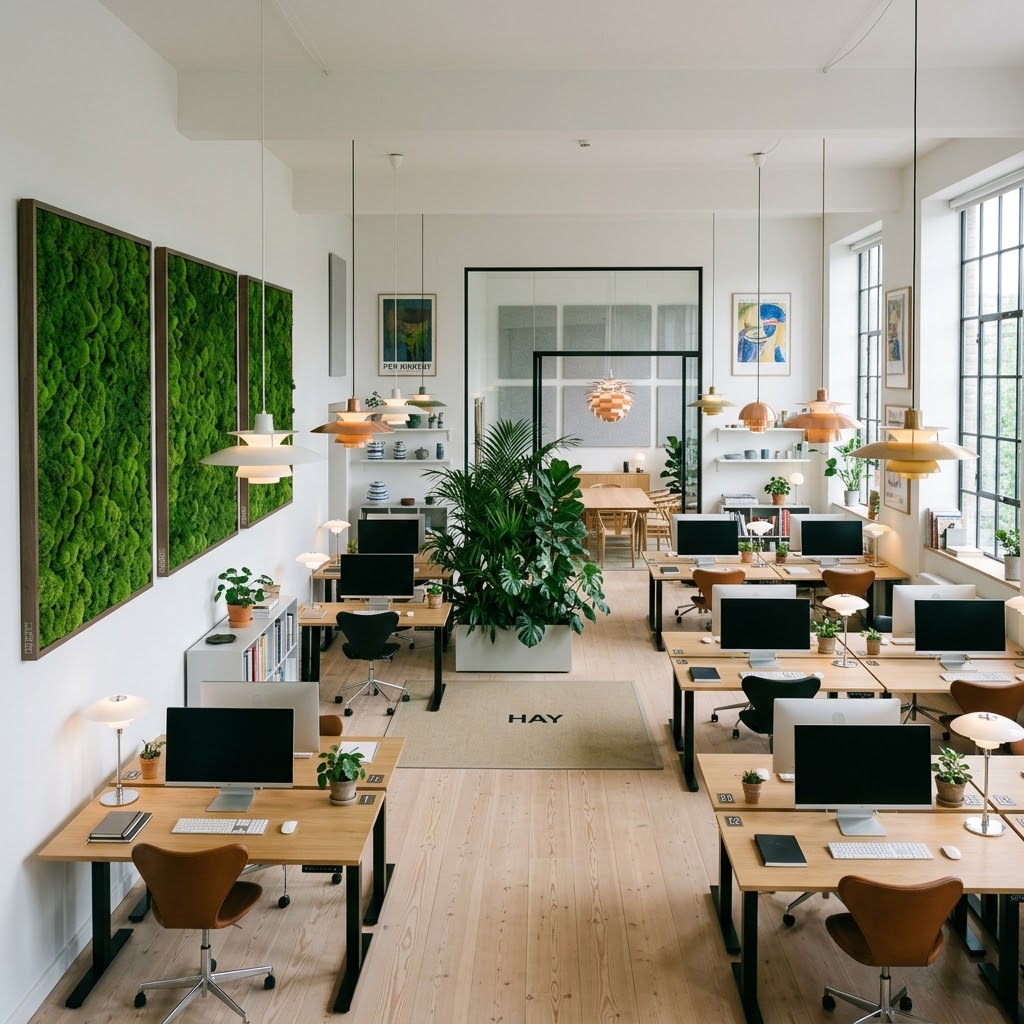
Moss walls and frames aptly fulfill form and function in this Danish Design workspace. Biophilic Design by: The Fat Plant Society
The Financial Reality: Payroll vs. Real Estate
When presenting the business case for biophilic design to executive stakeholders, the financial rationale hinges on comparing payroll density with capital outlay.
TYPICAL CORPORATE OPERATING EXPENSES
┌─────────────────────────────
In typical knowledge-worker organizations, salaries and benefits account for 85% to 90% of total operating expenses, while facility construction and interior finishes represent less than 10%.
Because personnel is by far the largest financial commitment, even a modest 1% to 2% improvement in workforce productivity or a slight reduction in absenteeism can offset the capital investment in biophilic upgrades within the first year.
Conclusion
Moss walls and interior greenery are far more than an interior finishing; they are a scientifically validated tool for cognitive optimization and human health.
Green walls and designs are evidence-based and have a quantifiable return on investment in a variety of categories.
By aligning moss wall design with spatial design and lighting, we effectively meet the brain’s evolutionary needs so that the modern workplace environment can lower stress and unlock significant operational value, all while improving focus and well-being for the humans in that workplace.